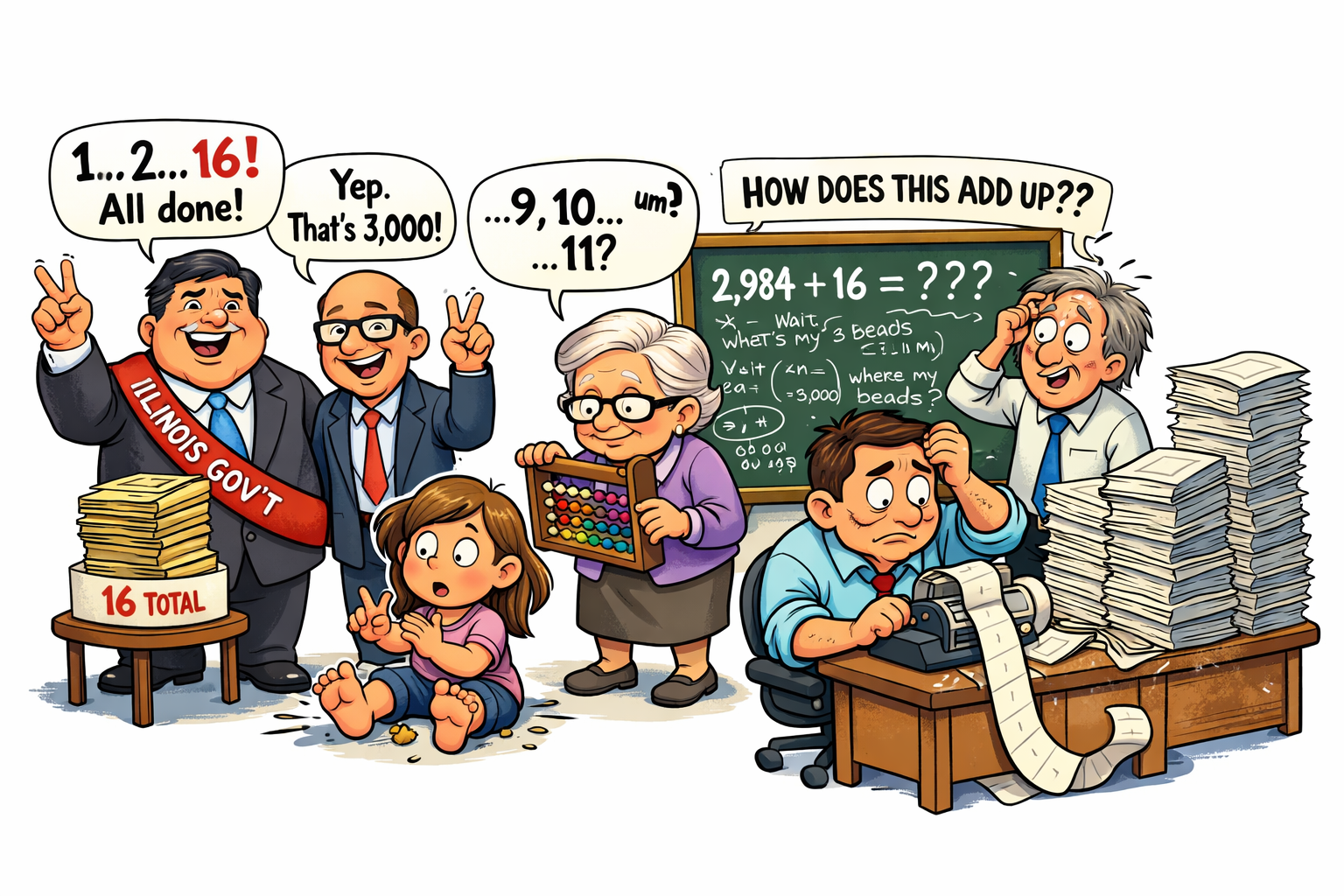
Deferment 2.0: How Illinois Elected Officials Count (and Why 3,000 Sometimes Equals 16)
Deferment 2.0: How Illinois Elected Officials Count (and Why 3,000 Sometimes Equals 16)
An exploration in procedural compression, institutional gravity, and why bureaucracy has a wicked sense of humor
There I was elbow-deep in emails with admissions offices about PhD programs, discussing research funding, thesis scope, and the finer points of Gravitas Satanae when the cosmos decided to deliver a FOIA reply so perfectly absurd that even Kafka would tip his hat and take notes.
But let’s set the stage with precision, because nuance is academic honesty’s oxygen:
In my earlier article The Weight of Deferral, I mused with all the seriousness of someone who has learned to hold both coffee and skepticism at the same time that eventually I would request the 3,000-plus responsive records that a certain Illinois office had been politely deferring since 2018.
Three thousand. Plus.
It was not a rhetorical flourish. It was a FOIA request.
And what came back?
Sixteen.
Yes. Sixteen. Not even including what I requested…
Not enough to fill a shoebox. Not enough to count past your fingers and toes. Certainly not enough to confirm that we’ve reached half of 32. But apparently sufficient to declare, in the unmistakable voice of administrative closure:
“No records withheld.”
No, really.
I’ll give you a moment to absorb that.
Because if we think of scale the way most adults do (e.g., “a hundred is a lot, a thousand is a lot more, and three thousand is almost cartoonishly large”), then this response mathematically speaking occupies some undiscovered dimension of bureaucratic compression.
To be clear: I am not an expert in the physics of FOIA outputs, but I do know that:
16 is not 3,000
3000 is not 16
The difference between them is exactly 2,984
And yet, according to the government’s math, we have reached completion.
Now, before we accuse anyone of laying the foundations of an alternative reality, let’s remember something critical:
Procedural compliance does not always equate to perceptual coherence.
In other words, you can follow every rule in the sky and still produce a timeline that looks like someone shoved the universe through a bureaucratic funnel and forgot to check the output dial.
So let’s unpack what just happened, because there’s a method hidden inside this comedy of numbers:
1. Original request filed with anticipated 3,000+ responsive files. High-dimensional data universe.
2. Agency response is 16 produced, FOIA closed, no records withheld, nothing to see here.
3. Procedural closure declared complete. And yet unmistakably incomplete.
Now, as someone whose thesis framework explicitly investigates how unresolved procedural obligations accumulate structural gravity over time, this real-world encounter is more than amusing. It is empirical.
In Gravitas Satanae, we argue that:
Systems designed to defer, constrain, or compress information will, over time, generate internal pressures that eventually demand reconciliation not through force, but through accumulation.
And what is this 16-file response if not accumulation manifest?
Sixteen files released from a request that logically implies thousands that is a vector of procedural mass. It is not obstruction. It is compression.
And in bureaucratic physics, compression increases gravity.
To put it in more accessible terms (or at least terms that will make your statistician friend spit out their coffee):
When a dataset collapses from 3,000 to 16, the missing mass doesn’t disappear it simply changes form, residing in the interstices of interpretation and administrative discretion.
That is not a scandal.
That is not a conspiracy.
That is a structural artifact.
And that, my friends, is exactly the kind of pattern that makes disciplines and departments uncomfortable.
But let’s be honest: Illinois elected officials counting this way is not a moral indictment it’s existential comedy. It’s like finding out that the Dinosaur Exhibit has 16 bones, and the tour guide insists that the rest is “on special reserve.”
Now let’s talk methodology.
If the agency truly believed there were only 16 files responsive to the narrowed request, that implies either:
• Their internal indexing is more creative than their public indexing, or
• Their search logic operates in some dimension parallel to ours.
But let’s accept the premise with academic charity: maybe only 16 files met the refined criteria after narrowing.
That still doesn’t explain the original inference of 3,000. Somewhere between the “universe of obligation” and the “universe of output” something got compressed like a Jackson Pollock painting in a mimeograph machine.
Which brings us back to theory:
Structural gravity doesn’t dissipate when deferred; it accumulates.
Procedural closure doesn’t reduce systemic tension; it redistributes it.
In the context of FOIA and public accountability, this phenomenon has implications:
• It highlights the difference between compliance and completeness
• It illustrates how procedural response can mask information mass
• It reveals how administrative closure can coexist with epistemic opacity
All without anyone committing an actual rules violation.
That’s where the real fun begins.
Because once you strip away claims of malfeasance and look only at process outcomes, what we have here is not corruption in the dramatic, melodramatic sense. It’s procedural opacity; it’s institutional indistinctness; it’s the way rules can be followed without satisfying the spirit of inquiry.
And that, dear reader, is the very substrate upon which Gravitas Satanae rests:
When structural mass accumulates quietly across fractured procedural domains, the system’s internal gravity increases until it can no longer maintain coherence without some form of adaptive response.
Or, to put it another way:
If a government answers a 3,000-file request with 16 files, and no one calls bullshit, then the weight of that silence becomes a structural feature of the institution.
You want experimental epistemology?
You’ve got it.
You want real-world administrative physics?
Here it is.
You want the punchline?
This:
Comedy is just seriousness with a better timing mechanism.
And as anyone applying to a doctoral program while simultaneously conducting granular FOIA fieldwork will tell you:
There’s nothing more amusing and more structurally informative than watching the universe push back on your request for data with the intellectual equivalent of:
“Here, have these 16 files. Best we could do. Thanks for playing.”
So let’s not frame this as suppression.
Let’s frame it as an empirical test of institutional gravity.
If we keep filing requests in batches of 20, 100, 500 whatever the agency’s internal counting system feels comfortable with then we begin to observe not just what exists, but how the institution chooses to represent what exists.
And that difference that chasm between production and promise is where structural exposure lives.
Because in systems where deferment becomes a strategy, the only way out is through visibility.
And nothing increases visibility like accumulation.
Even if, in Illinois, 3,000 looks suspiciously like 16.
And before anyone at the funding bodies thinks this confirms their question that I’m drafting a blueprint for government collapse I’m not. I’m studying how routine administrative procedure, when layered, deferred, and compressed, can unintentionally generate gravitational stress points within institutional systems. Lawful mechanisms, when used repetitively and defensively, can create opacity, misalignment, and structural tension even in the absence of overt wrongdoing. My research doesn’t pull systems down. It turns the lights on and lets gravity do what gravity has always done: respond to mass. That mass is simply the accumulated weight of institutional decisions.That’s the weight of their own decisions.
That is Gravitas Satanae.
Update for transparency: In the ongoing adventure of administrative linguistics, the office of the Attorney General reached out and now clarified that the prior “burdensome” discussion referred to the 16 file subset only based on their interpretation not the full 3,000+ list. How am I going to get the 3000+ files if they claimed their burdensome was for their interpretation of 16 files? Additionally, we’ve learned that the Public Access Counselor lives in a fascinating jurisdictional dimension adjacent to, but apparently distinct from, the Office of the Attorney General and not under their agency. Someone should update the state hierarchy structure, it’s printed wrong everywhere.
Government structure: always educational.